
Traffic safety professionals often look to crash reports and public complaints to help identify dangerous streets. But to address safety risks before crashes happen, experts are turning to connected vehicle data (CVD) for granular insights into real-time driving behaviors and leading indicators of crash risk.
Watch an expert roundtable with panelists from Maricopa Association of Governments, Purdue University, and Iowa State University as they demystify CVD and share best practices for using the precise, granular data for traffic safety planning and operations.
You'll learn:
-
 Innovative ways leading researchers are using CVD to improve real-world traffic safety
-
How to spot wrong-way driving, hard braking, and other safety hazards using CVD
-
Why Connected Vehicle Data is becoming a key tool for traffic safety professionals
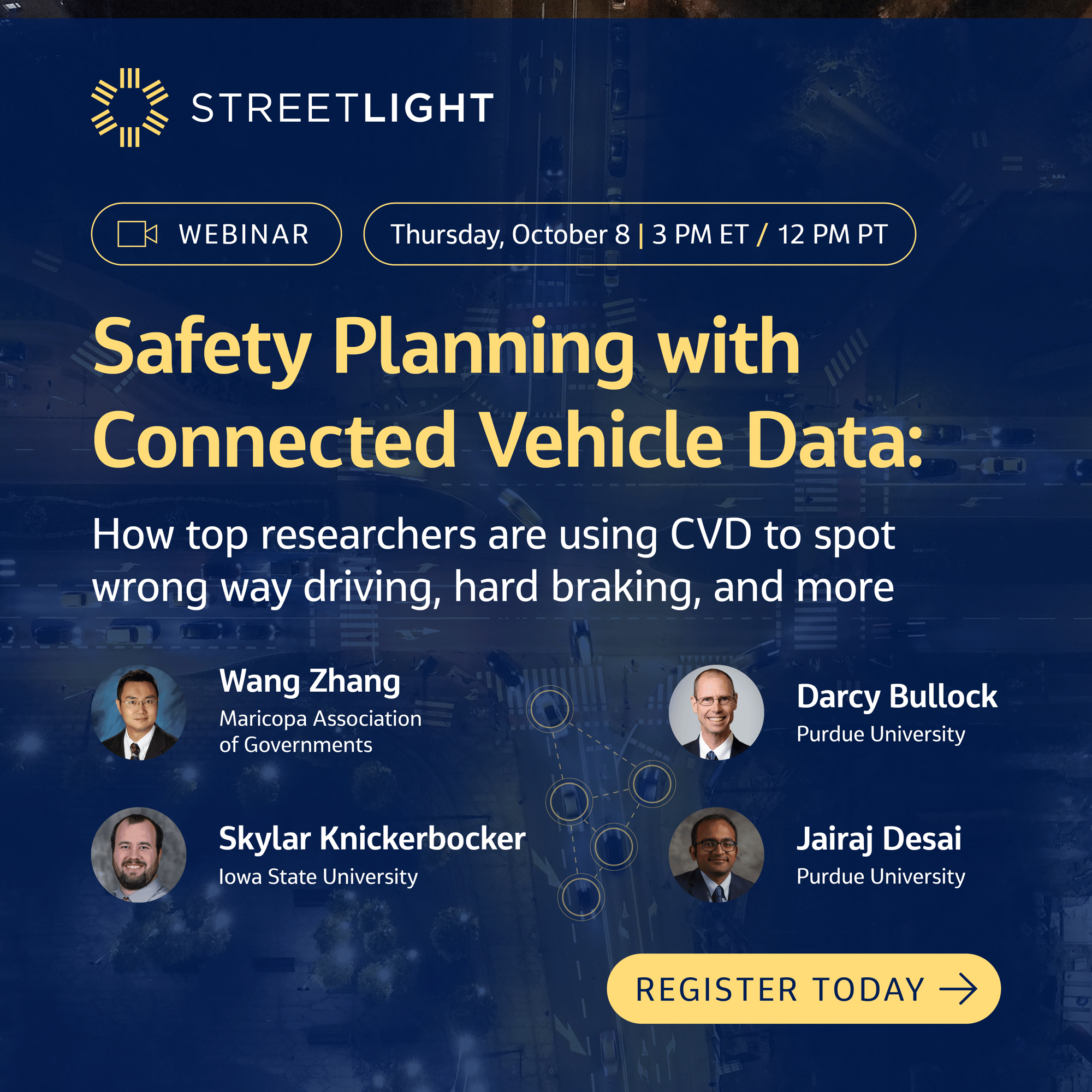
Speaker Bios

Dr. Wang Zhang serves as Transportation Data Manager at the Maricopa Association of Governments (MAG, Phoenix region MPO), where for more than two decades he has specialized in integrating and analyzing diverse traffic and mobility data to better understand and improve regional transportation systems.

Mr. Skylar Knickerbocker is a researcher and co-director of the Real-Time Analytics in Transportation (REACTOR) Laboratory. He works primarily in the areas of traffic operations, maintenance, and safety, including data analytics, data visualization, and big data management.

Dr. Darcy Bullock is the Lyles Family Professor of Civil Engineering and Director of the Joint Transportation Research Program at Purdue University.

Jairaj Desai is a Transportation Research Engineer at Purdue University.
Address safety risks earlier with Connected Vehicle Data

Spot dangerous traffic patterns like wrong-way driving and hard braking.
Deploy interventions proactively based on real-time & historical traffic data.
Evaluate the impact of infrastructure or policy changes with immediate access to before-and-after insights.
