
Operations teams don’t just manage traffic—they manage ripple effects.
Lane closures, construction activity, signal inefficiencies, and even weather events can quickly lead to queuing, delays that impact the broader network, and safety risk. The challenge isn’t just reacting—it’s understanding what’s happening across the network and responding before disruptions compound.
That’s why agencies are turning to ongoing, real-time network-wide traffic monitoring from their desktop to track queues, validate field conditions, and make more informed operational decisions—without relying on additional hardware.
Join us for a discussion with Houston METRO on how StreetLight’s Traffic Monitor is helping teams move from reactive responses to proactive management.
You'll learn:
-
 How Houston METRO is using StreetLight's Traffic Monitor to improve transit delays
-
How a networkwide, real-time view of traffic alongside historical data can transform roadway operations
-
Real-world examples of traffic monitoring to improve work zone safety, congestion management, and resiliency planning
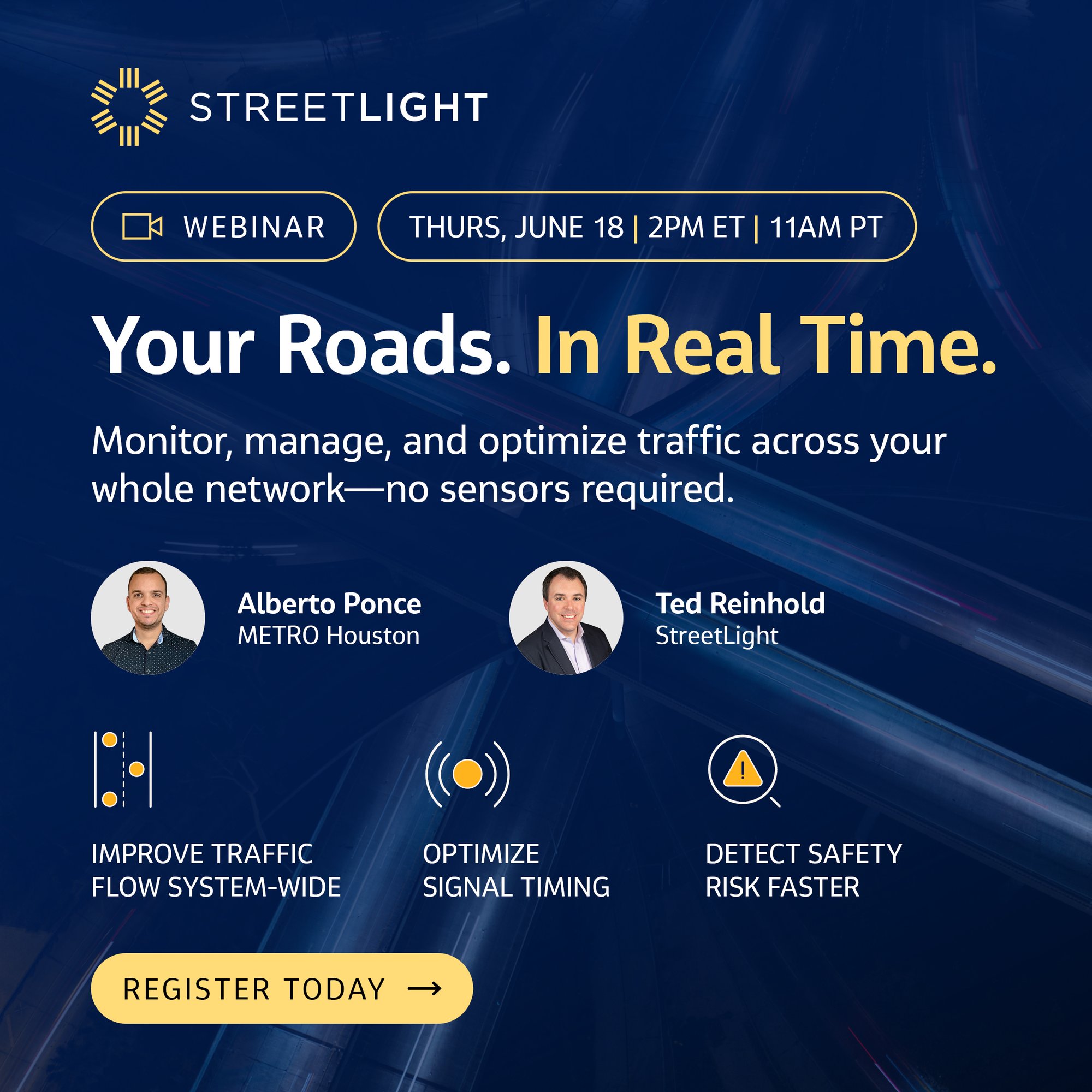
Panelist Bios
.jpg?width=768&height=1024&name=Alberto%20Ponce%20(1).jpg)
Alberto Ponce is a Senior Transit Planner in the System & Capital Planning group at Metropolitan Transit Authority of Harris County. He previously worked with Harris County's Engineering Department and is working towards a combined degree in architecture, planning, and engineering fields. In addition to participating in the METRO's long-term capital and long-range planning initiatives, Alberto is involved with efforts to maintain and improve existing transit infrastructure throughout planning, design, and construction of the State's North Houston Highway Improvement Project (NHHIP).
.jpg?height=2000&name=Ted%20Reinhold%20high%20res%20(1).jpg)
Ted Reinhold is a Senior Solutions Engineer at StreetLight where he works with public and private sector agencies to uncover their most pressing issues using Big Data. Prior he worked at AECOM as a lead consultant. Mr. Reinhold has a Master of Science in Transportation Engineering and a Master of City and Regional Planning, Transportation from Ohio State University. He also holds a Bachelor of Science in Civil Engineering from the University of Notre Dame.
Minimize driver frustration and reduce traffic disruptions

Dynamically adjust traffic controls using real-time speed and incident data
Respond to residents’ concerns with a network-wide view of traffic disruption impacts
Improve detour planning and address bottlenecks by observing driver routes and travel times
